Select Format / Edition
Book Details
- Language
- English
- Paper Quality
- 80gsm Off-White Creamy Pages
Synopsis
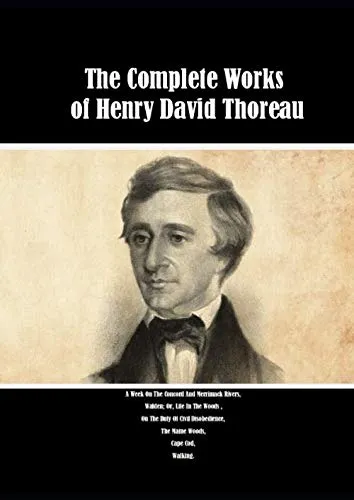
Henry David Thoreau, the American essayist, poet, and philosopher, stands as a leading figure of transcendentalism. He is celebrated for *Walden*, a meditation on simple living amid nature, and for the essay known as "Civil Disobedience," originally published as "Resistance to Civil Government," which argues for defiance of an unjust state. *A Week on the Concord and Merrimack Rivers* grew out of a boating trip Thoreau took with his brother in 1839 from Concord, Massachusetts, to Concord, New Hampshire. Ten years in the making—it was the book he retreated to Walden to write—it weaves together essays, journal passages, and some of his finest poems.
*Walden* is at once a personal declaration of independence, a social experiment, and a voyage of spiritual discovery, framed by the seasonal cycle of a year's "Life in the Woods." Its refrain of "Simplify, simplify" urges the abandonment of waste and illusion, a reckoning with life's essential needs, and a new economy for humane living. *The Maine Woods* recounts three journeys by boat and canoe in 1846, 1853, and 1857 through an unexplored interior that westward expansion had bypassed, describing Maine's virgin rivers and forests, the customs of woodsmen and Indian guides, the hunting of moose, and the effects of the timber industry and encroaching settlement. *Cape Cod* is the bleakest of his works, its prose recalling Melville in its vision of nature's titanic indifference; the Cape appears as both ocean and desert, a vast expanse of shipwrecks and barren soil inhabited by hardy, weathered people who seem survivors from the age of the first Pilgrims.
"Walking," sometimes called "The Wild," was written between 1851 and 1860, with portions drawn from his earlier journals; Thoreau read it aloud ten times, more than any other of his lectures, and it was first published as an essay in the *Atlantic Monthly* after his death in 1862. "Resistance to Civil Government" ("Civil Disobedience"), first published in 1849, contends that individuals must not let governments overrule or atrophy their consciences, and that they have a duty to refuse complicity in injustice—a conviction motivated in part by Thoreau's disgust with slavery and the Mexican–American War.