Select Format / Edition
Book Details
- Language
- English
- Paper Quality
- 80gsm Off-White Creamy Pages
Synopsis
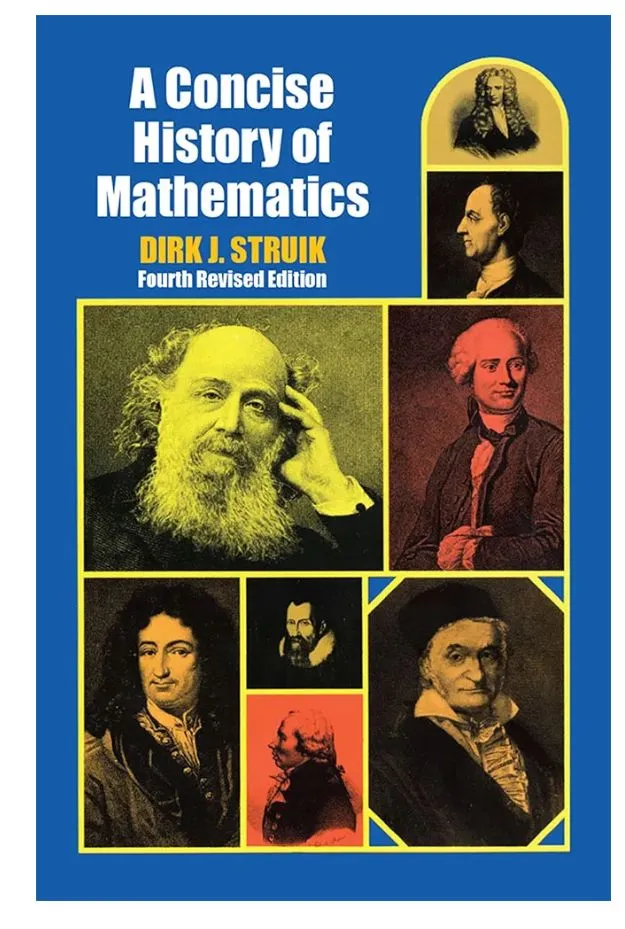
First published in 1948 and now in its fourth revised edition, this compact and well-written history traces the main currents in the development of every branch of mathematics, from the earliest surviving records to the middle of the twentieth century. Students, researchers, historians, and specialists—anyone with an interest in the field—will find it engrossing and stimulating.
The narrative opens in the ancient Near East, following the ideas and techniques that took shape in Egypt, Babylonia, China, and Arabia through manuscripts such as the Egyptian Rhind Papyrus, the Ten Classics of China, and the Siddhantas of India. It then moves through Greek and Roman developments, from their origins in Ionian rationalism to the fall of Constantinople, before turning to medieval European thought and Renaissance trends, the contributions of the seventeenth and eighteenth centuries, and a illuminating account of nineteenth-century concepts. Every major figure in the history of mathematics receives attention—Euclid, Archimedes, Diophantus, Omar Khayyam, Boethius, Fermat, Pascal, Newton, Leibniz, Fourier, Gauss, Riemann, Cantor, and many others.
For this latest edition, Dr. Struik has revised and updated the existing text and added a new chapter on the mathematics of the first half of the twentieth century. It offers concise coverage of set theory, the influence of relativity and quantum theory, tensor calculus, the Lebesgue integral, the calculus of variations, and other important ideas, concluding with the dawn of the computer age and the seminal work of von Neumann, Turing, Wiener, and others. As Nature Magazine observed, the author's ability as a first-class historian and an able mathematician has produced a work that is unquestionably one of the best.